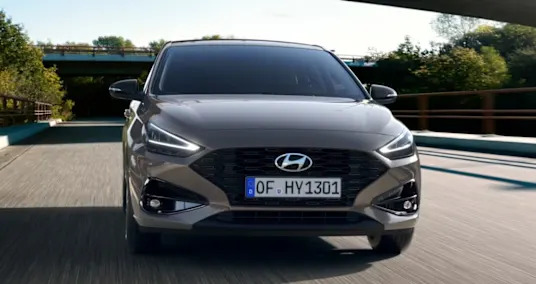
Hyundai is keeping the i30 alive a little longer, at least until its fully electric successor is ready to take over. The refreshed Hyundai i30 for the 2026 model year is preparing for its European rollout with a simplified engine lineup and a more streamlined range of trim levels. The update is deliberately subtle, signaling continuity rather than reinvention.
The decision underlines Hyundai’s commitment to the C segment, still one of the most important categories in Europe. While many rivals are accelerating their transition to fully electric lineups, Hyundai is taking a more gradual approach. Hyundai has not officially confirmed a direct i30 successor yet, but an upcoming compact EV often referred to as the IONIQ 3 is expected to target a similar part of the market, while the i30 hatchback and i30 Estate remain on sale for now.
Design Updates Focus On Color And Trim

Visually, the 2026 i30 does not reinvent itself. Instead, Hyundai has focused on fine-tuning the offering through details. The updated model introduces a revised color palette with ten exterior shades in total. Among them is the new Sailing Blue finish, available exclusively with the Trend trim, and Jupiter Orange, reserved for the sport-oriented N Line and N Line X versions."
Why: Hyundai Motor Deutschland names the two exclusive colors Sailing Blue and Jupiter Orange for the German market announcement.
The i30 continues to be offered as a five-door hatchback and as the i30 Estate wagon. Buyers looking for a sportier appearance can still choose between two N Line trims, which emphasize visual aggression without stepping into full performance-model territory.
Strong Standard Equipment Across The Range

Even the entry-level Trend trim comes generously equipped by segment standards. Hyundai includes a wide array of safety and comfort features as standard, such as front, side, and curtain airbags; ABS and ESC; hill start assist; a multi-collision braking system; and an electronic parking brake.
Driver assistance is also comprehensive. The i30 features a camera-based driver attention monitoring system, lane keeping and lane following assistance, and adaptive safety systems designed to support everyday driving. Full LED headlights, rain and light sensors, an auto-dimming rearview mirror, tire pressure monitoring, front and rear parking sensors, and a reversing camera are all standard.
Inside, buyers get heated front seats, dual-zone automatic climate control, a wireless phone charger, USB ports for both front and rear passengers, and a fully digital cockpit. A 10.3-inch digital instrument cluster is paired with a 10.3-inch infotainment display with built-in navigation, wired Apple CarPlay and Android Auto, and eCall emergency connectivity.
N Line And N Line X Add A Sportier Edge
The N Line trim adds more dynamic interior and exterior details, including aluminum pedals, a drive mode selector, a sportier steering wheel with paddle shifters for automatic versions, and a smart key system with push-button start.
At the top of the range, N Line X brings a more complete, sport-oriented package. This includes 18-inch alloy wheels, a fabric and leather upholstery combination, and a driver seat with a memory function, plus additional safety equipment such as a knee airbag, with other driver assistance content depending on market and options.
Simplified Engines And German Market Pricing

In Germany, Hyundai Motor Deutschland announced the 2026 model year lineup and pricing on February 2, 2026, and the i30 is offered with two gasoline engines. The entry-level option is a 1.0-liter turbocharged three-cylinder producing 115 horsepower, paired exclusively with a six-speed manual transmission. Above it sits a 1.6 liter turbocharged four-cylinder with 150 horsepower, available only with a seven-speed dual-clutch automatic.
In Germany, list prices start at €28,650 (about $31,000) for the i30 five-door with the 1.0 T GDI in Trend trim. With the 1.6 T GDI and the seven-speed dual-clutch automatic, list prices start at €33,150 (about $36,000) in Trend trim, then €34,650 (about $38,000) for N Line and €36,650 (about $40,000) for N Line X. The i30 Estate is €1,000 more at each step, starting at €29,650 (about $32,000) with the 1.0 T GDI and reaching €37,650 (about $41,000) for an N Line X with the 1.6 T GDI.
A Transitional Model Before Full Electrification
This simplified lineup makes the i30 range easier to understand and manage, but it also signals that the model is entering a transitional phase. Hyundai clearly sees the i30 as a bridge toward a fully electric future rather than a long-term pillar.
Rollout to other European markets is expected within weeks, ensuring uninterrupted availability. What remains market dependent is engine choice, as some regions still receive lower-output naturally aspirated options. For now, though, the refreshed i30 continues to play a steady supporting role as Hyundai prepares for the next chapter.
This article originally appeared on Autorepublika.com and has been republished with permission by Guessing Headlights. AI-assisted translation was used, followed by human editing and review.




 Consumer experts: German petrol hikes rule won't bring down prices
- Find the Standards of Viable Refereeing: Settling Debates with Strategy
- Artemis will take Americans to the moon for the 1st time since 1972. Why has it been so hard to go back?
- Treason trial of South Sudan's suspended VP is further eroding peace deal, UN experts say
- Germany's Pistorius: NATO protects Europe from Iranian missiles
- Disney's latest short film 'Versa' tackles a difficult subject: Pregnancy loss. It's resonating with viewers.
- Intriguing Social Unesco World Legacy Locales All over The Planet
- Germany paves the way for tighter EU asylum rules
- China's 'Venice Of The East' Is A Historic Canal City Near Shanghai With Arched Bridges And Lantern-Lit Waterways