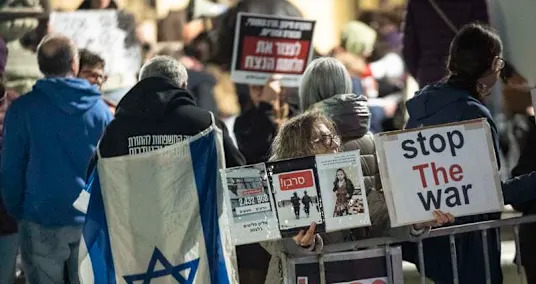
Demonstrators carried signs reading “We must stop” and “Bibi will kill us all,” while about 200 people gathered at Horev Junction in Haifa.
Anti-war demonstrations were held across Israel on Saturday evening, with protesters gathering in Tel Aviv, Haifa, Jerusalem, and Kfar Saba despite strict wartime restrictions on public assembly.
Demonstrators carried signs reading “We must stop” and “Bibi will kill us all,” while about 200 people gathered at Horev Junction in Haifa.
Earlier on Saturday, the Home Front Command granted an exceptional permit for a protest of up to 150 people at Habima Square in Tel Aviv, after state authorities told the High Court of Justice that demonstrations would be allowed only in a limited format and under tight attendance caps.
The Association for Civil Rights in Israel sought an urgent hearing, arguing that the restrictions harm the right to protest.

Security restrictions and court dispute
One IDF officer said the Home Front Command examined each requested protest site individually on operational, professional, and security grounds, including proximity to protected spaces. As a result, authorities did not approve a large gathering at Habima Square and instead allowed only 50 to 150 participants near a shelter.
The officer said the military declined to provide further details on all of its security considerations, but offered to present them to the court in a closed session.
“We are acting professionally and objectively. There is no political consideration here or any other consideration,” he said.
The requests covered several locations, including Habima Square in Tel Aviv, Horev Center in Haifa, Paris Square in Jerusalem, and Weizmann Street in Kfar Saba. In Tel Aviv, the state told the Supreme Court that the protest could proceed in two separate groups of up to 75 people each, for a total of 150 participants.
Protest groups push back
Police and the Home Front Command said the limits stemmed from operational and security concerns, against the backdrop of fears of missile fire and broader wartime restrictions on gatherings.
Civil rights lawyers, however, argued in court that earlier judicial remarks on the importance of political free expression during wartime had not been meaningfully implemented.
The dispute followed a tense High Court hearing on Friday, during which Supreme Court President Isaac Amit sharply criticized the state’s position.
The judges stressed that the right to protest does not disappear during war and said police should propose a framework that would allow demonstrations to proceed.
最近の投稿
- 1
 'The Housemaid' movie with Sydney Sweeney and Amanda Seyfried premieres this month. What the stars have said about the psychological thriller.
 - 2The Fragrant Small Tree Birds & Pollinators Love With Stunning Flowers In Summer
- 3Nikki Glaser has been testing out Golden Globes jokes. There's one nobody wants to hear
- 4Radiate brilliantly: The 5 Precious stone Rings to Purchase in 2024
- 5How color-changing, bacteria-infused spacesuits could help keep future astronauts safe from space radiation



- 'Outrageous and illegal' : UNRWA slams Israel for cutting off its water, comms and electric in Gaza
- As juries turn against social media for harming kids, Big Tech's invincibility starts to show cracks
- The Main 15 Powerful Business Heads of Today
- RSF attack on Sudan’s South Kordofan kills at least 14, including children
- Obamacare enrollment declines as US subsidies expire
- Native artists in Texas and Mexico shared their vision of the universe for 4,000 years, ancient murals suggest
- The Best Web-based Courses for Ability Advancement
- Email Promoting Instruments for Compelling Efforts
- ByHeart sued over recalled formula by parents of infants sickened with botulism