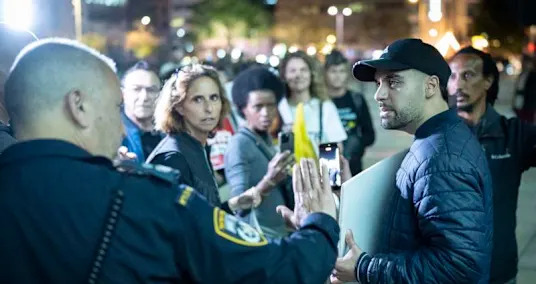
Protests took place in Tel Aviv, Jerusalem, Haifa, and Beersheba, as a survey found broad but uneven support among Jewish Israelis for Operation Roaring Lion.
Israel Police arrested 21 anti-war protesters Saturday night as demonstrations against the conflict with Iran expanded in multiple cities despite restrictions on public gatherings.
Protests took place in Tel Aviv, Jerusalem, Haifa, and Beersheba, with hundreds of participants reported in Tel Aviv and Jerusalem and about 100 in Haifa, marking the largest turnout since weekly demonstrations began. Authorities said 13 people were arrested in Tel Aviv and eight in Haifa.
Police said the gatherings were not approved under Home Front Command regulations that ban events with more than 50 people. Officials said the increase in turnout followed calls by groups opposing the government to protest despite the restrictions.
“During a situation assessment that took place at the scene with a Home Front Command representative… it was clarified that there was a real risk to human life and accordingly, Yarkon [precinct] police commander Tzachi Sharabi ordered the gathering to be dispersed,” police said.
Hadash-Ta’al chairman Ayman Odeh, an Arab lawmaker involved in the protests, criticized the police response, calling officers fascists “in the service of the government” and saying they were afraid of “the heroic citizens who went out, despite everything, to make their voice heard.”

Survey shows broad, uneven support for war
The demonstrations come as a March 2026 survey by the Israel Democracy Institute found broad but uneven support among Jewish Israelis for Operation Roaring Lion. Support was strongest on the Right at 87% and about half on the Left.
The survey also found that Jewish and Arab respondents largely agreed that Iran’s resilience has been stronger than expected. Most Jewish respondents said Israeli society could sustain the campaign for up to one month, while 28% said as long as needed. Arab respondents were less optimistic about how long the public could endure the conflict.
A majority of Jewish respondents said Prime Minister Benjamin Netanyahu’s decision was driven by security considerations, while most Arab respondents viewed it as political.
最近の投稿
- 1
 Songbirds swap colorful plumage genes across species lines among their evolutionary neighbors
 - 2Global measles cases drop 71% in 24 years as vaccination coverage improves, WHO says
- 3Blue Origin's next space tourism flight will break new ground for people with disabilities
- 4Charlotte faith leaders hold interfaith forum on Black and Palestinian solidarity
- 5Islamabad: Iran allows 20 Pakistani ships through Strait of Hormuz



- US healthcare spending soars to over $5 trillion in 2024
- From Educational Loans to Obligation Free: Independence from the rat race Accomplished
- Sydney Sweeney's American Eagle campaign and Kendrick Lamar's Super Bowl performance were among the 10 biggest pop-culture moments of 2025
- Figure out How to Explore Land Close to 5G Pinnacles
- Manual for Purchasing a Modest Jeep Wrangler for Seniors
- Figuring out Significant Regulations and Guidelines for Organizations
- 5 things for parents to know about changes to kids vaccine schedule
- At least 36 dead in major fire in Hong Kong residential blocks
- Instructions to Plan for Your Teeth Substitution Methodology


